> For the complete documentation index, see [llms.txt](https://docs.kemperconnect.de/llms.txt). Markdown versions of documentation pages are available by appending `.md` to page URLs; this page is available as [Markdown](https://docs.kemperconnect.de/common/register-device.md).
# Register Device
This page explains how to add a new KEMPER unit to the KEMPER Connect platform.
If you have a new KEMPER device that is compatible with the KEMPER Connect platform, it must be registered to your site (workspace) before it can be used.
The registration process is straightforward and only takes a few steps.
## Prerequisites
To register a KEMPER device on the KEMPER Connect platform, you will need:
* The device **serial number**
* The corresponding **PIN code**
These details can be found on the device’s type plate (also referred to as the license plate), which is attached directly to the unit. The type plate typically includes both the serial number and the PIN required for registration.
### Cannot find the Serial Number or PIN?
If you are unable to locate the serial number or PIN code on the device, please contact KEMPER Support for assistance.
You can also use the live chat feature available in the bottom-right corner of the KEMPER Connect platform.
## Registration Process
To register a device:
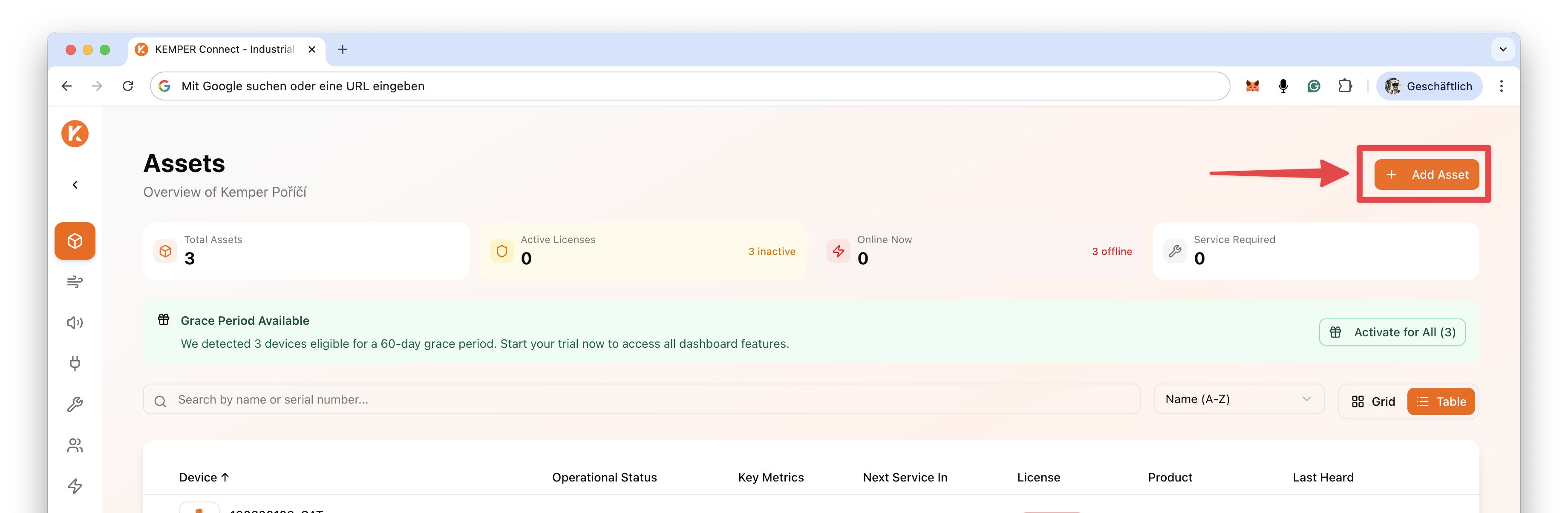
1. Navigate to the **Asset List** within your site.
2. Click the **Add Asset** button.
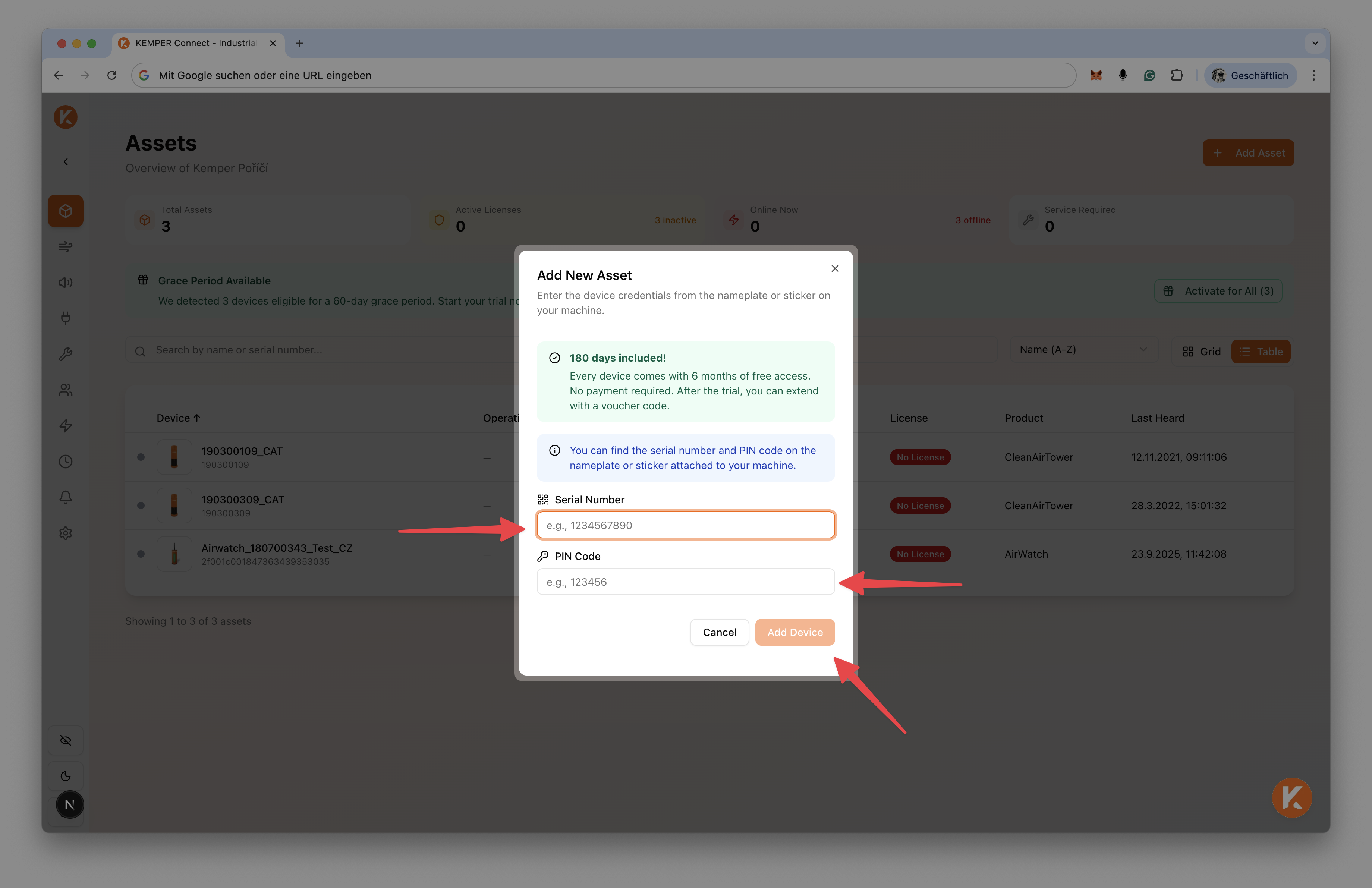
3. The **“Add New Asset”** dialog will open.
4. Enter the serial number and PIN code exactly as shown on the device’s type plate.
5. Confirm the registration.
Once the information is validated, the device will be added to your workspace.
### License Included
Newly registered devices automatically include a 180-day (six-month) free access period.
This trial period is activated automatically upon successful registration. No additional steps are required.
---
# Agent Instructions
This documentation is published with GitBook. GitBook is the documentation platform designed so that both humans and AI agents can read, navigate, and reason over technical content effectively. Learn more at gitbook.com.
## Querying This Documentation
If you need additional information that is not directly available in this page, you can query the documentation dynamically by asking a question.
Perform an HTTP GET request on the current page URL with the `ask` query parameter, and the optional `goal` query parameter:
```
GET https://docs.kemperconnect.de/common/register-device.md?ask=&goal=
```
`ask` is the immediate question: it should be specific, self-contained, and written in natural language.
`goal` is optional and describes the broader end goal you are ultimately trying to accomplish on behalf of the user. GitBook uses it to tailor the answer towards what is most useful for that goal.
The response will contain a direct answer to the question and relevant excerpts and sources from the documentation.
Use this mechanism when the answer is not explicitly present in the current page, you need clarification or additional context, or you want to retrieve related documentation sections.